
Our hair is more often stressed during the summer season than the rest of the year. Just like our skin, it needs to be pampered and well protected. In this article, we'll tell you about the damaging effects of the sun, salt water, and more on your hair. Of course, we'll also give you some tips on how to care for it. This way, your hair will stay strong and shiny all summer long, and logically, all year round!
Summer is great! But not really for our hair...
-
The sun severely degrades our hair:
If we expose our beautiful hair in a reasonable and exceptional way, the sun is not harmful. On the contrary, it gives them natural highlights and promotes the synthesis of vitamin D, which itself helps calcium to bind to the hair. In addition, the sun stimulates blood circulation at the root of the hair, which irrigates the scalp.
The sun, at first glance, may seem very beneficial for our hair. But... be careful, it can quickly become an enemy for them! It dries out the scalp, and alters its pH, which can lead to dandruff. It also burns the keratin naturally present in our hair. The sun's rays are also disruptive and slow down the evacuation of fatty acids present in the sebum... These then stagnate under the epidermis, turn into toxins and degrade the roots. The hair is then heavily stressed, it becomes thinner, fragile and falls out much more easily. Our hair can also be discolored due to excessive and too frequent sun exposure.
-
Wind doesn't help...
Wind is great when it's very hot, when it cools us down and we feel like a star with our hair blowing in the wind... No, more seriously, wind isn't the worst natural element for our hair, but it's not its best ally either. Indeed, it also dries out hair. Frizz multiplies, hair gets tangled and then breaks.
-
Chlorine, our hair's worst enemy:
Chlorine, present in a large majority of swimming pools, is very bad for our hair. It tends to make it dull and dry. For blond and colored hair, it can be a disaster... Chlorine can change the color and make it greenish. In addition, the effect of chlorine on our hair reduces the hair's natural protective oil, which causes a significant lack of hydration. This loss of oil necessarily damages our hair by drying out the hair fiber. The natural sebum initially present to protect the scalp disappears and gives way to chlorine which makes our hair brittle.
-
Seawater isn't their best friend either:
Once again... What a joy to go for a swim on a short day at the beach to cool off and, for the lucky ones, to discover marine environments and their beautiful fish. However, you must be careful, because the iodine-rich seawater can strongly dry out your hair and make it frizzy. The latter can also impact the pH of your scalp and thus make it much more sensitive and irritable. Your ends will tend to fray and will gradually become very split. Salt water will weaken and dry out your hair. Salt and sand can cause abrasion of the hair and lift the scales, a very harmful action for it.
Sun, wind, chlorine, salt water, sand, heat... Too many elements damage our hair, especially in summer. It becomes difficult to style and loses its soft and shiny appearance... A shame, isn't it?
Simple and effective tips to fight against hair destruction in summer.
Here are some tips to limit this damage, or even prevent it altogether. Take care of your hair in summer by applying these daily tips. They can save your hair! If you adopt the right habits, you'll know how to prevent and protect your hair from the natural elements that can destroy it.
-
Do not use heated tools.
Straighteners, hairdryers, curling irons... These styling tools are destructive for our hair. In addition to the summer heat, if you continue to use these tools... It's guaranteed disaster. Your hair will be dry, burned and beyond repair.
-
Bye-bye hairspray.
Indeed, very useful when you want to fix a styled hairstyle for example, but it is very destructive for your hair. It acts as a "barrier" against humidity and wind but terribly dries and stiffens the hair. You understand... Hairspray + sun = bad combo!
-
Vegetable oils are great for pampering your hair.
Contrary to what some information suggests, putting oil on your hair will not make it fry, provided you use vegetable oils. Yes, some processed oils mixed with other chemical ingredients can burn your hair when heated by the sun. Tanning grease is typically a product whose components are catastrophic (petroleum is the main one) and can easily destroy your hair fiber.
Nevertheless, some vegetable oils contain a natural filter that forms an anti-UV layer on the hair. The smoke point of these oils is important to consider, even if in most cases, it is high and therefore poses no risk. It represents the temperature at which oils or fats continuously emit smoke.
Coconut oil has a smoke point of 177°C, 230°C for castor oil and sweet almond oil, 160°C for sunflower oil, 271°C for avocado oil, and 160°C for wheat germ oil.
The best oil to take care of your hair this summer is raspberry seed oil. It deeply nourishes your hair, its smoke point is 215°C, and it has a sun protection factor between 28 and 50. All pure vegetable oils provide good nutrition to your hair, but with varying intensity.
Wheat germ oil, avocado oil, and coconut oil have a sun protection factor of 15 and are also great for your hair. The oils can be mixed together. These oils cover our hair with a protective film and protect it from the sun's UV rays.
-
Avoid contact between your hair and sea or pool water.
-
Oil baths will make your hair happy.
-
A pretty cap or a nice hat?
- 6 hairstyle ideas by "Kim Tout Court" 🡪 https://www.youtube.com/watch?v=Mxcdsby2iVI
- Summer hairstyle ideas with a scarf 🡪 (303) Pinterest
-
Rinse your hair after swimming.
-
In summer, you need to drink a lot, and so does your hair!
-
The swimming cap, not very glamorous but super effective
-
Detangling operation
One of our tips, which can sometimes be difficult to apply when you love swimming, refreshing your face or body in summer, is to limit contact with this type of water as much as possible. Indeed, sea or pool water tends to damage your hair.
To do this, tie your hair up to prevent water and sand from sticking to it and breaking it. Braids are relatively simple to make and they limit the appearance of knots. This is one of the best alternatives!
Another, equally simple, alternative is to wet your hair before swimming. Indeed, the scalp acts like a sponge, meaning it soaks your hair with clear water. This way, your hair will be saturated with clear water, which reduces the space available to absorb chlorinated or salty water. You can therefore wet it in the shower or with a (reusable, of course 😉) bottle. This will make your hair less sensitive.
Before or after sun exposure, remember to do regular oil baths. The vegetable oils mentioned in tip #3 are also valid at home. To promote the penetration of the oil into your hair, you can cover your head with a hot towel. There are also microfiber towels that are soft and won't damage your hair. Your cuticles will open up and absorb the oil to strengthen your hair fiber. You can apply the oil to all of your hair before shampooing, focusing on your lengths and ends. Leave it on for at least 30 minutes and you're done! Your hair will be nourished, silky, and ready to face the summer!
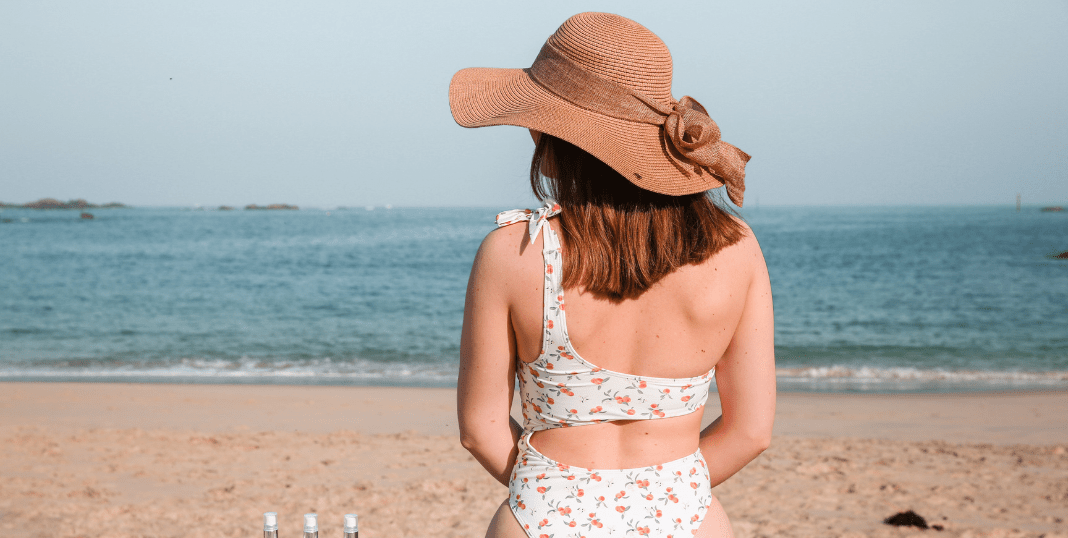
Try not to expose your head when you're in the sun. First of all, the risk of sunstroke can be more or less high. But your hair is also put to the test. Caps and hats are the most common accessories you can see on a beach. You can also opt for pretty hairstyles, using different accessories such as a turban, a scarf, a headband, ... Many quick tutorials are available on Pinterest or YouTube.
Here are some links that may be useful to you:
By keeping your hair safe from external natural elements, you can rest assured and not have to worry about wind, sun, etc.
One thing not to forget is to rinse your hair with clear water once your swim is over. This will help limit the harmful effects of external natural elements that can get into your hair. You need to evacuate salt, pollution, sand, chlorine as quickly as possible... If you don't have a shower nearby, remember to take a reusable bottle to rinse your hair after your relaxing moment basking in the sun.
When you shampoo, it's important to use a gentle shampoo that doesn't irritate your scalp; and always apply a treatment or mask to maintain your hair's hydration.
Hair hydration is essential. It is important to drink at least 1.5L of water per day. This way, your hair will be hydrated from the inside.
We also advise you to do a mask once a week, to nourish them from the outside this time. This can be with coconut, jojoba, argan, avocado or castor oil. Leave the mask on for a minimum of 15 to 20 minutes. But you can leave it on for several hours or even overnight.
Finally, try to reduce the number of shampoos you do per week to 1 or 2 times. Indeed, even if they eliminate impurities, they tend to dry out your hair and reduce the natural sebum that your scalp needs.
Wearing a swimming cap in summer is certainly not the most elegant accessory... But after all, why not? There are different patterns and pretty fabrics. It is obvious that with this on your head, your hair will be 100% protected. You will then no longer have to ask yourself questions when swimming and you will not risk losing your hair!
It's up to you, but it's an excellent alternative that allows you to preserve all of your hair in summer.
Some brushes tend to weaken your hair. Prefer a silk bristle brush or a wide-tooth comb. The direction in which you brush them is essential to preserve their beauty. Contrary to what you might think, you should start by combing your ends then gradually move up to the root. In addition, never brush your hair when it is saturated with salt or chlorinated water.
We hope these valuable tips will help you. These small gestures are easy to do this summer and promise to keep your hair beautiful throughout the summer!!
To go further: how to repair dry hair?

Leave a comment
All comments are moderated before being published.
This site is protected by hCaptcha and the hCaptcha Privacy Policy and Terms of Service apply.